
Submerged Crocodile
It’s no coincidence that the main way to reach this place is by way of the river that borders it, where the ancient structures seem to rise straight out of the dense jungle.

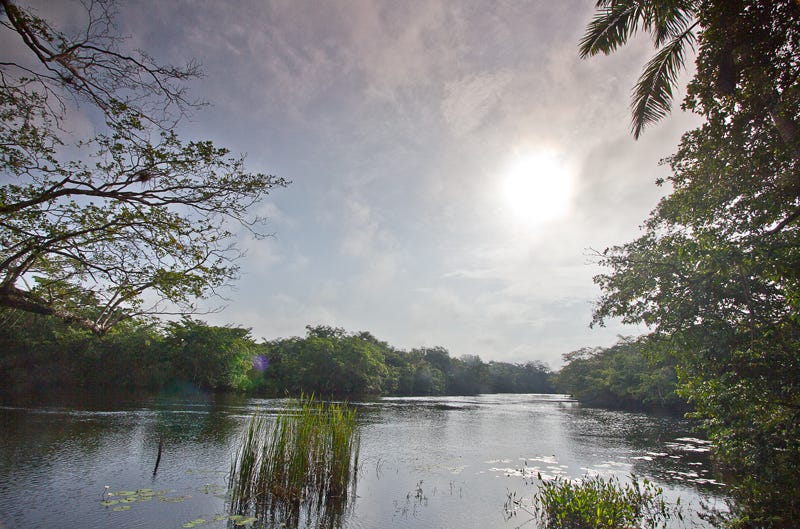
(Spanish version: Cocodrilo sumergido).
Occupied for more than three thousand years and located in Belize, Lamanai was one of the longest continuously inhabited Maya sites. The New River snakes through the site, almost inviting you to approach by water rather than land—a wise choice, since depending on the time of year, the rough, muddy roads might require a vehicle capable of handling challenging terrain.
I could say that the magic begins on that river. But that would be either a lie—or, at best, an inaccuracy. Belize remains a mystery to much of the world. It’s better known for its stunning islands than for its mainland. In Latin America, it’s a country few talk about, and even fewer visit. Even its immediate neighbors often regard it cautiously, and a significant portion of the Mexican border population has barely ventured into Belize—aside from the free zone and its casino.
For me, the magic begins at the border crossing. From the very first time—and despite the warmth of the people—it was a small challenge to navigate the instructions given by Belizean agents, whose English I could barely understand given that my English isn’t particularly strong and their accent was new to me, and where everything seemed to follow a kind of cheerful improvisation that somehow made everyone involved smile. As a curious side note, the first time I entered, I did so driving a 2012 VW Beetle. During inspection, the officer asked me to open the hood to check for any belongings. He was surprised to find the engine there and asked why it was in the front. To him, a Beetle was still the original rear-engine model, and it was clear he had never seen a New Beetle—even though that model had been around since 1998.
Not just because of this incident, but even in general, it always felt to me that time moved differently in Belize.
I arrived by river. And that’s how you should reach Lamanai too—because it’s part of the magic. You know the river is full of crocodiles, but it’s one of the "prices" you gladly pay to stand before a four-meter-high stucco mask—one of the best preserved and largest in the entire Maya world still accessible to us.
I treasure every memory from this trip, but one event in particular, left a permanent mark—something that, at the time, I had no idea would be so remarkable. After visiting the site, my wife and I returned to our hotel along the riverbank. We sat on a bench located on a raised platform, a few meters above the river, built to prevent floods from reaching the hotel. It was about two meters high, ending abruptly like the edge of a rooftop at a 90-degree angle. We sat there talking for about an hour and even exchanged a few words with an American journalist staying at the same hotel.
As we were getting ready to leave, my wife approached the edge to snap a photo of the river. Just then, a loud, startling noise shattered the calm. Had I not been watching, I would have thought a car had fallen into the water. But I was sitting there, looking straight at the scene, and still couldn’t immediately understand what had just happened.
What had happened was that a huge crocodile, which had been resting silently on the concrete wall just beneath us, had suddenly launched itself into the river. Somehow, this crocodile had been silently listening to our entire conversation, and none of us had noticed it was there.
In the end, it slipped back into the water—the same place all the crocodiles of this incredible land come from. Because Lamanai’s name comes from the original Maya word Lama'an'ain, which means "submerged crocodile."